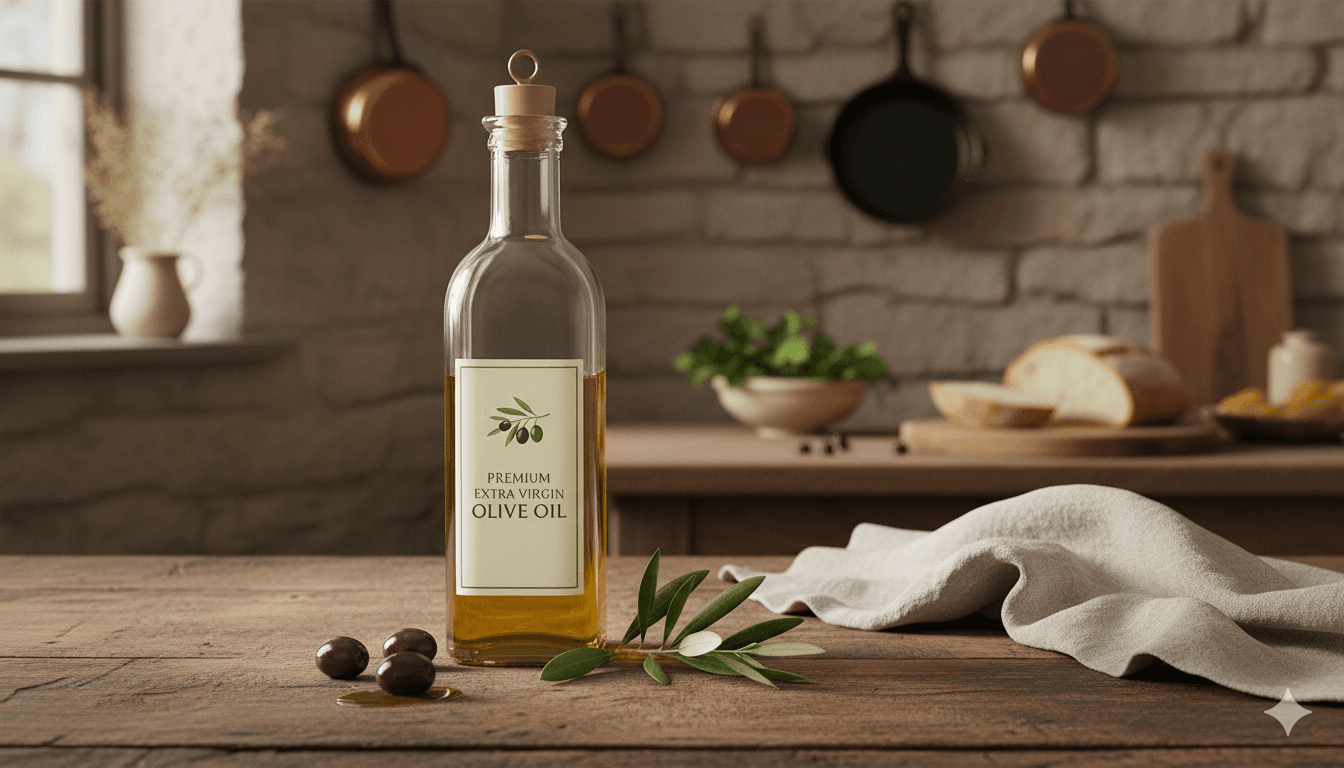
The Clean Hero Lie: What Craft Beverage Brands Get Wrong Before the Camera Is Even Unpacked
Most craft beverage brands ask for an image that says "this is expensive." The only question that sells is "is this for me?" Here's the difference — and the three jobs your imagery needs to be hired to do.
"This image nails the Trust Job. It leaves the Identity Job and the Utility Job completely unaddressed. The rest of this post explains why that matters — and what to do about it."
Every craft beverage brand wants to look premium. Almost none of them ask what "premium" actually means to the customer standing in front of the shelf. This post is about the difference between an image that says "this is expensive" and an image that says "this is for you" — and why only one of them sells.
The Brief That Kills the Sale
Walk into almost any craft distillery, boutique winery, or independent brewery in the country and ask the owner what they need from a photographer. The brief will be some variation of the same request.
They want a hero shot. Bottle centered, perfectly lit, label sharp enough to read every word. Maybe a single glass beside it — filled precisely, garnish placed just so, a large clear ice cube catching the light. Premium. Magazine-worthy. The kind of image that makes a $45 bottle look like it belongs on the shelf next to a $150 one.
They've thought carefully about this. The amber hue of the whiskey, the clarity of the pour, the exact texture of the label. They want every detail visible. Every detail perfect.
And the brief is wrong before the first light goes up.
Not because the hero shot is a bad photograph. Some of the most technically demanding work in commercial photography is a perfectly executed bottle shot — and we'll get to what makes one actually work in a moment. The brief is wrong because it treats photography as a finishing touch rather than a strategic lever. It asks for an image that says "this is expensive" when the only question that matters is "is this for me?"
Most craft brands try to look like The Best. The ones that win look like The Only.
There is a meaningful difference. The Best is a comparative claim — it puts the brand in a race it probably can't win against established players with larger production budgets and more shelf presence. The Only is an identity claim. It says: this product exists for a specific person, in a specific moment, for a specific reason that no one else is addressing. You can't out-produce The Only. You can only out-story it.
Photography is how that story gets told. Or doesn't.
What Backlighting Actually Does to a Spirit
Before we talk about what craft beverage photography gets wrong, we need to talk about what it gets right when it's executed at the highest level — because understanding the physics and psychology of great beverage lighting is the foundation for everything else.
When you backlight a spirit — whiskey, a rich red wine, a craft amber ale — you aren't simply illuminating a bottle. You are turning the liquid into its own light source.
The physics of glass and fluid interact in a specific and remarkable way. When the light source is correctly sized and positioned behind the bottle, the liquid grabs the light and pulls it toward the center of the vessel. This creates a luminous gradient — the core of the bottle glows with more intensity than the edges, giving the liquid apparent depth and three-dimensionality that front lighting can never produce. Front-lit, a bottle of whiskey is a flat object you look at. Back-lit correctly, it becomes an experience you want to move toward.
For a spirit like whiskey, the transformation is dramatic. The amber shifts from a muddy, undifferentiated brown to what I think of as a molten core — a fiery, crystalline orange-gold that radiates from the center of the frame. The gradient runs from deep burnt umber at the base to a bright, glowing honey-gold where the light hits the meniscus at the top.
This isn't just aesthetically beautiful. It's doing something neurological.
Human beings carry millions of years of hardwired attraction to glowing objects — fire, embers, the last light of a sunset. When a whiskey bottle glows from within, it triggers that same primal comfort response. The warm, luminous amber reads as safe, inviting, and premium — not because we've been taught to associate it with quality, but because our nervous systems were calibrated to move toward warm light long before any of us had an opinion about whiskey.
Backlighting also communicates something more specific: clarity as a quality signal. A properly back-lit liquid looks clean. The light reveals the absence of sediment, the purity of the distillation, the crystalline quality of the liquid itself. It tells the viewer this is vibrant and alive — not a stagnant chemical product, but something that was made with precision and care.
This is where the Clean Hero shot has legitimate strategic value. For a small local distillery fighting the "Amateur Penalty" — that consumer hesitation of is this actually good, or is this someone's hobby project? — a technically perfect hero shot with correct backlighting serves a specific purpose. The sharp focus, the molten core, the crystalline clarity are a proxy for quality control. You aren't just selling whiskey. You are selling the data-backed assurance that the distillation process was as precise as the photography.
The hero shot earns its place. It's just not the whole job.
The Guinness Problem: A Hero Shot With a Pulse
Consider a pour shot I've done of a dark stout — mid-action, foam cresting, slightly uneven, alive rather than staged. The backlighting through the glass body creates exactly the gradient I described: deep mahogany at the base, warming toward amber where the light hits the meniscus. The bottle beside the glass is a clean, controlled hero. But the glass is a moment. That tension between the static bottle and the kinetic pour does real emotional work. It says: the product exists, and the experience is already in motion.
What the image doesn't have — and this is an honest self-assessment, not a criticism — is what I'd call Narrative Residue.
No condensation run on the glass. No wet ring on the surface beneath it. No evidence that a hand was here a moment ago and will be here again in a moment. The pour is the one gesture toward life. Everything else is still pristine. The image is technically accomplished and emotionally controlled — which is exactly right for a brand at Guinness's scale, operating at Guinness's budget, communicating to Guinness's global audience.
But if this were a craft stout from a Fort Myers taproom trying to make someone feel the specific warmth of a dimly lit corner booth on a Friday night — this image would be the wrong tool. Not because it's bad. Because it's solving a different problem for a different brand in a different moment of a customer's purchase journey.
The brief determines the image. Always.
Narrative Residue: The Proof of Life
Here's the concept that separates beverage photography that sells from beverage photography that gets admired and forgotten.
In a hero shot, perfection is the goal. In lifestyle photography, perfection is a lie that kills the craving.
When an image looks like a sterile laboratory experiment where a beverage happens to be present, the emotional connection evaporates. The viewer's brain — which is a pattern-recognition machine that has spent decades learning to identify the visual grammar of advertising — sees the artifice immediately. Not consciously. Instinctively. The stock photo alarm fires before a single thought forms.
What triggers that alarm is the absence of what I call Narrative Residue — the physical evidence that life was happening in this frame before the camera arrived, and will keep happening after it leaves.
Real life leaves marks. A craft beverage is consumed in a social ritual that involves other humans, food, movement, and time. The residue of that ritual is what makes a scene believable — and believability is the prerequisite for craving.
Consider what Narrative Residue actually looks like in practice:
The discarded citrus twist. Not a perfectly cut garnish placed at a precise angle. A twist that was expressed over the glass — oily, slightly irregular, dropped casually on the surface beside it. If you look closely, there are microscopic droplets of citrus oil still visible on the surface of the liquid. That detail communicates that someone made this drink with intention and then actually drank it.
The condensation ring. A perfectly wiped table surface screams stock photography. A dark slate coaster with a faint wet ring from where the glass was lifted a moment ago tells a completely different story. The ring is proof: someone was here. Someone picked up that glass. Someone will pick it up again.
The imperfect head. A beer with a perfectly flat, soapy head looks dead. A pour with foam still cresting, still settling, still in motion says something specific about time: this is happening right now.
And timing is everything.
The Moment of Peak Vitality
There is a microsecond in every pour — every beer, every cocktail, every spirit hitting a glass over ice — when the image is most alive.
For beer, it's the instant the foam crests above the rim, still climbing, not yet settling. For a whiskey over hand-cracked ice, it's the moment the first melt starts — when the jagged edges of the ice are still sharp but the first bead of dilution is visible at the base of the glass. For a cocktail, it's the instant after the shake, when the frost is forming on the outside of the tin and the first pour hits the glass with visible temperature.
I call this the Moment of Peak Vitality. And capturing it is one of the most technically demanding things a beverage photographer can do — because it requires understanding not just the camera, but the chemistry of the product, the physics of the ice, and the timing of the pour.
Miss it by five seconds and you have a dead image. A beer with a flat head. A whiskey in a glass that looks like it's been sitting there for twenty minutes. A cocktail that has lost its chill. The product looks like a product. The craving never forms.
Get it right and something happens in the viewer that bypasses the logical brain entirely.
The specific element that crosses the line from "great photograph" to "I need that right now" is almost always something small and specific. Not the bottle. Not the composition. Not the lighting setup, as important as that is.
It's the run.
A thick layer of frost on the outside of a glass — that matte, velvety bloom that only happens when a glass is truly, painfully cold. And right through the middle of that frost, a single heavy bead of condensation has just started its path down the glass. It has left a perfectly clear, transparent trail behind it, revealing the vibrant color of the drink through the fog.
That single drop of water is communicating three things simultaneously, at a speed faster than conscious thought:
Temperature. You can practically feel the cold on your teeth before you've formed the thought "that looks cold."
Texture. The contrast between the matte frost and the glossy trail creates a tactile response — the brain reaches for the sensation of a cold glass in a warm hand.
The Moment. That drop is moving right now. The image has a clock in it. If you don't reach into the frame and pick up that glass, the cold will be gone.
It stops being a photograph of a drink and starts being a countdown to a reward.
It's the visual equivalent of hearing a steak sizzle in a quiet restaurant. You don't admire the sound. You start looking for your fork.
The Three Jobs an Image Gets Hired to Do
Here's where the data science background becomes directly relevant — because what I just described isn't a creative philosophy. It's a conversion funnel analysis.
When a client says "make it look good," they usually mean "make it look successful." But in a competitive craft beverage market, success is measured by one metric: does this image eliminate a specific friction point in the customer's purchase journey?
Before a single light goes up in my studio, the strategic question I'm trying to answer is: which friction point is this image designed to remove?
There are three jobs a beverage image typically gets hired to do. Trying to solve all three in one frame produces the stock photo that solves none of them.
Job 1: The Trust Job — Reducing Perceived Risk
For a small local distillery, the most common friction point is the Amateur Penalty. The consumer sees an unfamiliar label and wonders: is this actually good, or is this someone's hobby project?
This is where the technically perfect hero shot earns its place. The molten core backlighting, the crystalline clarity, the precise label rendering — these are a visual proxy for quality control. The image is making an implicit argument: the care that went into this photograph is evidence of the care that went into this distillation. The photography isn't decoration. It's a trust signal.
Job 2: The Identity Job — The Customer Mirror
Craft spirits are rarely bought for the liquid alone. They are bought for what the liquid says about the person holding the bottle.
If the data on the target customer shows a "Rugged Individualist" — someone who self-identifies as discerning, independent, the kind of person who seeks out the local and the authentic over the mass-produced — then a sterile studio shot is a strategic failure. Not because it's bad photography. Because it's answering the wrong question. It's saying "this is premium" when the customer needs to hear "this is for someone like you."
This is the Identity Job, and it requires Narrative Residue. The firelight in the background. The jagged hand-cracked ice. The evidence of a life being lived rather than a product being presented. The image needs to function as what we discussed in the previous post in this series — a mirror that shows the customer a slightly better, yet entirely reachable, version of their own reality.
Job 3: The Utility Job — Building Mental Availability
The third friction point is subtler and more common than most brands realize. The customer already likes the brand. They've tried the product. They'd buy it again. But they don't.
Why? Because they don't know when to drink it.
This is a usage occasion problem — and it's solved almost entirely through imagery. What specific gap in the customer's week does this beverage fill? The highball at sunset on a screened porch in Southwest Florida. The craft stout beside the grill on a Sunday afternoon. The glass of wine that signals the workday is over and the evening has begun.
Strategically, this image is building what consumer researchers call mental availability — a concept formalized by marketing researcher Byron Sharp — the automatic association between a product and a specific moment or emotional state. You aren't showing the customer the bottle. You are showing them the reward. If the image successfully links the product to a specific time, place, and feeling, you've shortened the distance between "I've heard of that brand" and "I'm buying that tonight."
Before the Lights Go Up
The craft beverage market is crowded. Every category — spirits, wine, beer, RTD cocktails — has more options than any consumer can meaningfully evaluate. In that environment, the brands that win aren't always the ones with the best liquid. They're the ones whose imagery answers the right question at the right moment.
The Clean Hero on a Pedestal answers one question: is this premium? It's a legitimate answer to the Trust Job. But it leaves the Identity Job and the Utility Job completely unaddressed — and in a market where the consumer already believes your product is probably good, "probably good" isn't the friction point anymore.
The question worth asking before any shoot, for any brand, at any budget level, is the same one I ask before I plug in a single light:
What does this image need to do in the world?
Not look like. Not feel like. Do.
If the answer is "eliminate the Amateur Penalty for a new local distillery," shoot the Trust image. If the answer is "make a specific kind of person feel like this bottle was made for their life," shoot the Identity image. If the answer is "make someone who's been meaning to buy this brand actually buy it on the way home tonight," shoot the Utility image.
That's not a creative philosophy. That's a business methodology with a camera attached.
It stops being a photo of a drink and starts being a countdown to a reward. It's the visual equivalent of hearing a steak sizzle in a quiet restaurant. You don't admire the sound. You start looking for your fork.
Kevin Boller is the founder of Insight Image Studio, a commercial photography studio specializing in product and beverage imagery. With 20 years in data analytics and 10 years behind the camera, he works with brands that are ready to treat photography as a business asset — not a creative expense. Based in Southwest Florida, working worldwide.